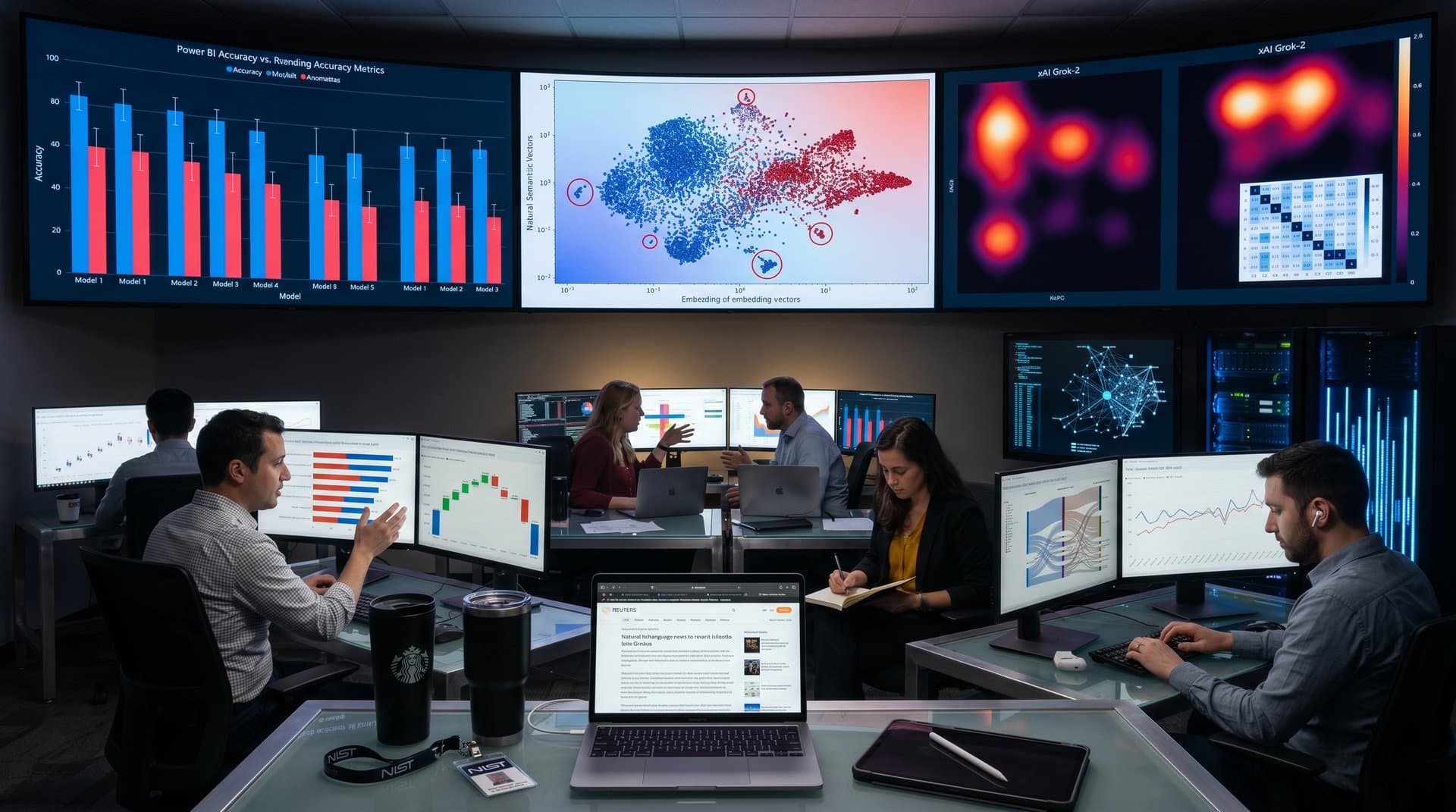
- AI-driven data visualization processes 100,000 rows/second to filter military intel overload.
- Tableau and Power BI maximize data-ink ratio with scatter plots and small multiples.
- US Army cuts MDMP time from days to hours using AI BI dashboards.
AI data visualization revolutionizes military decision-making. It processes 100,000 rows per second during mission analysis, per Microsoft Power BI specifications. Small Wars Journal reports commanders deploy Tableau and Power BI to combat sensor and intel overload.
Traditional Mission Analysis Struggles with Data Volume
Legacy paper maps bury critical signals in noise. Chartjunk violates Stephen Few's principles, per his book "Show Me the Numbers." Commanders overlook patterns across thousands of data points from drones and satellites.
AI algorithms filter noise and flag statistical anomalies. Power BI auto-detects outliers in MDMP Step 2, the military decision-making process.
AI-Driven Data Visualization Maximizes Data-Ink Ratio
Edward Tufte's data-ink ratio quantifies meaningful ink versus decoration. AI tools strip excess fluff. Tableau's Show Me feature recommends optimal charts, such as scatter plots for threat correlations, following Few's hierarchy: position > length > angle > area > volume.
Small Wars Journal (2024) details AI fusing drone feeds and satellite imagery into cohesive dashboards.
Build Effective Mission Dashboards in Tableau
Tableau connects directly to military data lakes. Calculated fields normalize scales to prevent lie factors, per Tufte's "The Visual Display of Quantitative Information."
VizQL engine renders visuals at high speeds. Tooltips enable drill-downs without visual clutter. Parameter actions support what-if scenarios for troop deployments and logistics.
Bar charts excel here over pie charts, as length perception aids accurate comparisons of unit strengths across battalions.
Power BI Excels for Defense Intelligence Teams
Power BI integrates Azure for DirectQuery on petabyte-scale intelligence data. Microsoft states it handles 100,000 rows per second.
AppSource incorporates ArcGIS geospatial layers for real-time troop tracking. DAX formulas let analysts build custom metrics, such as threat probability scores.
The platform visualizes financial data too, like the $858 billion USD FY2024 defense budget (per Department of Defense Comptroller). Cloud pricing starts at $10 USD per user per month, per Microsoft (2024). Embed reports in SharePoint for role-based access.
Data-Savvy Commanders Use Custom Tools
D3.js builds tailored visuals for specific needs. Python's Plotly creates interactive 3D battlespace models.
The US Army integrates AI to shrink MDMP timelines from days to hours, per army.mil (2024).
Edge AI synchronizes tablets with command systems during forward operations.
Proven Dashboard Design Patterns for High Stakes
Small multiples grid multiple scenarios for quick comparisons of courses of action (COAs). Bullet graphs track key performance indicators like response times.
Story points link visuals to intelligence briefs. Limit sparklines to 20 per view, per Few's guidelines.
Color-blind palettes meet WCAG standards for night operations and diverse teams.
Future Trends in AI-Driven Data Visualization for Defense
Generative AI builds dashboards from queries like "Map threat distributions by sector."
DARPA's AI Next program funds explainable AI research, per darpa.mil.
Quantum simulations model entire battlespaces. Data literacy trains squad leaders on BI tools.
AI-driven data visualization ensures operational precision and fiscal efficiency today.
Frequently Asked Questions
How does AI-driven data visualization enhance military mission analysis?
AI aggregates intel into low-ink charts, revealing patterns in chaos. Small Wars Journal reports faster MDMP cycles.
What BI tools support AI-driven data visualization in defense?
Tableau and Power BI connect data lakes with AI insights and geospatial layers for petabyte-scale intel.
Why use small multiples in military dashboards?
Small multiples enable efficient scenario comparisons using Few's principles for threat scans.
How does data-ink ratio apply to military BI?
AI maximizes signal ink, stripping chartjunk per Tufte for clarity in high-pressure mission briefs.