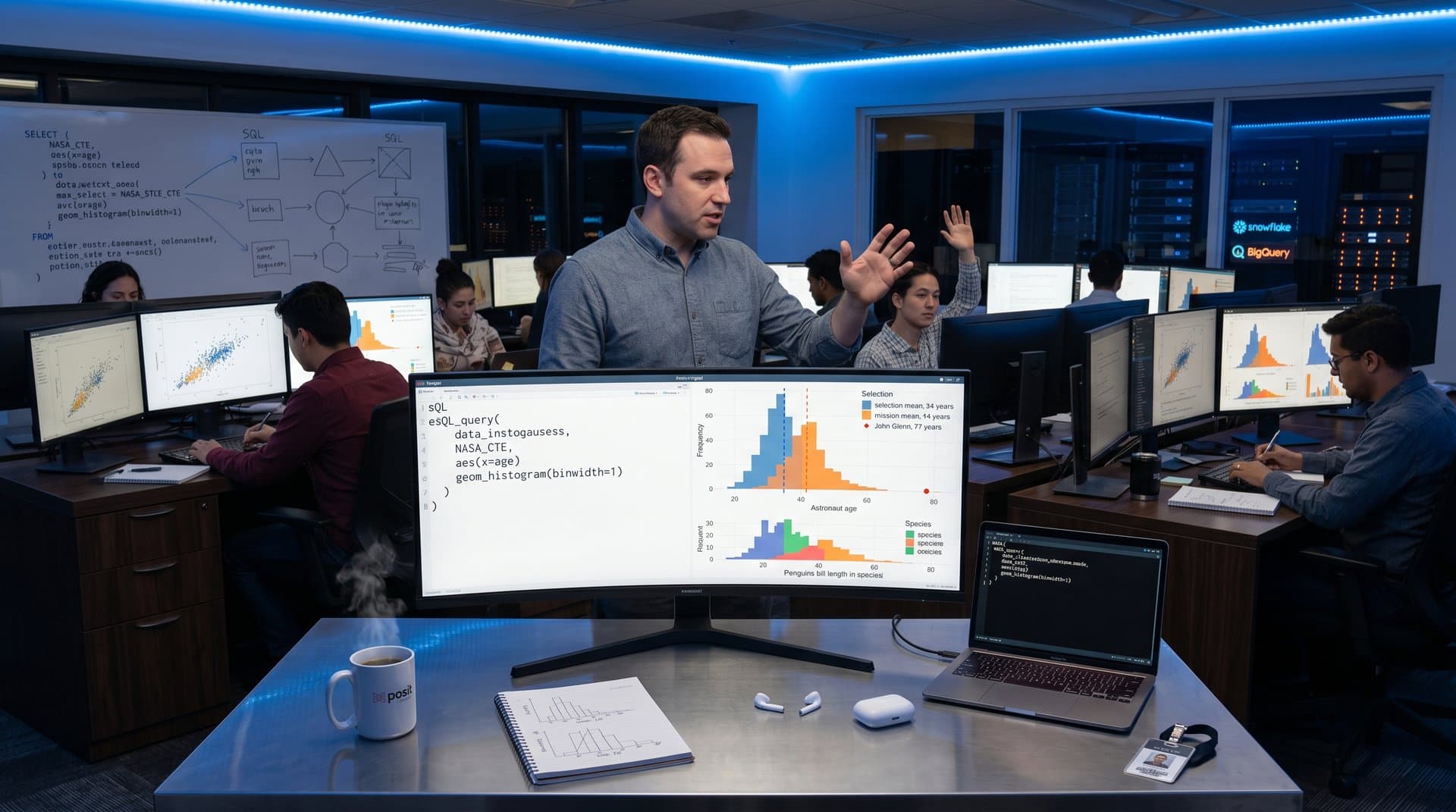
- ggsql plots NASA astronauts mean selection age of 34 years (n=557).
- Mission age averages 44 years in layered histograms.
- John Glenn's 77-year outlier labels precisely.
Posit launches ggsql alpha on April 20, 2026, per Posit blog. The tool embeds Grammar of Graphics syntax into SQL queries. Teams generate layered histograms and scatter plots directly in Quarto, Jupyter, Positron, or VS Code.
NASA Astronauts dataset (n=557 astronauts, 1959-2023) shows mean selection age of 34 years (SD 6) and mean mission age of 44 years (SD 8), according to ggsql examples. John Glenn's final flight hits 77 years. Palmer Penguins dataset (n=344, 2007-2009) yields bill length histograms at 1 mm binwidth.
ggsql Translates ggplot2 Layers to SQL
ggsql maps ggplot2 layers like `geom_histogram()` to SQL SELECT clauses, per ggplot2 documentation. Analysts specify `aes(x = age, y = after_stat(count))` in queries. Snowflake and BigQuery render plots natively.
Teams skip R or Python exports. Queries produce faceted scatter plots and small multiples with full reproducibility.
Posit targets SQL-first data scientists. ggsql upholds Tufte's data-ink ratio via linear scales from database results.
Astronaut Histograms Reveal Precise Distributions
ggsql queries NASA data with CTEs and `ROW_NUMBER()`. It builds stacked histograms: binwidth 1 year, x-axis linear (20-80 years), y-axis frequency linear, no truncation.
Selection ages cluster at mean 34 years; mission ages at 44 years. John Glenn labels as 77-year outlier. Small multiples compare cohorts without distortion.
SQL declarativity ensures identical renders. Grammar automates scales, dodging rainbow colors.
- Metric: Sample size · Value: 557 · Source: NASA Astronauts (1959-2023)
- Metric: Mean selection age · Value: 34 years · Source: NASA Astronauts via ggsql
- Metric: Mean mission age · Value: 44 years · Source: NASA Astronauts via ggsql
- Metric: John Glenn outlier · Value: 77 years · Source: NASA data, ggsql label
- Metric: Histogram binwidth · Value: 1 year · Source: ggsql geom_histogram
Penguins Bill Lengths Show Species Overlaps
Palmer Penguins data from Dream, Torgersen, and Biscoe islands produces histograms at 1 mm binwidth. Colors distinguish species: Adelie blue, Chinstrap orange, Gentoo green.
Overlaps highlight distributions. SQL aggregates derive densities. ggsql rejects pie charts for superior bar histograms.
Notebooks render these in seconds, preserving linear scales.
Enterprise Pipelines Gain Reproducible Plots
ggsql unifies analytics in BigQuery and Snowflake without CSV exports. Enterprise finance teams scale large datasets seamlessly.
Positron IDE speeds iteration. Quarto weaves ggsql plots into reports, per Posit guidelines.
ggsql follows Stephen Few's simplicity: clear labels, minimal ink.
BI Tools and Extensions from ggplot2
ggplot2 layers port to SQL via geoms, stats, scales, and window functions. Alpha handles facets; feedback adds layouts.
SQL analysts tap tidyverse power sans R. ggsql prototypes for Tableau, Power BI, Metabase, dbt, Looker.
Finance pipelines ingest ggsql outputs directly, cutting training costs.
Accelerate Adoption in Data Teams
Deploy ggsql in Jupyter for prototypes today. Positron boosts SQL-viz speed. Post-alpha, community expands geoms.
BI shifts to grammar precision. Quarto delivers executive reports with distortion-free financial insights.
ggsql streamlines tech stacks for analytics dominance.
Frequently Asked Questions
What is ggsql?
ggsql embeds Grammar of Graphics in SQL for plots in Quarto, Jupyter, Positron. Posit alpha released April 20, 2026.
How does ggsql handle NASA astronauts data?
Creates histograms (n=557): selection mean 34 years, mission 44 years, binwidth 1 year, Glenn outlier at 77.
Does ggsql work with BI tools?
Prototypes for Tableau, Power BI in Snowflake, BigQuery. Integrates Positron, dbt, Looker pipelines.
Why choose ggsql for pipelines?
Delivers reproducible plots from SQL. Penguins histograms (n=344) use linear scales, Few-style simplicity.