- North Carolina student cleared 39% Turnitin AI flag with perplexity scatterplots.
- Human perplexity averaged 28 vs. AI's 12 across 20 essays.
- Scatterplots reduce pattern errors by 50% per Cleveland-McGill studies.
Visualizing AI fingerprints cleared North Carolina student Timmy Clarence's 39% Turnitin AI flag. The Enloe High School senior plotted perplexity scores from OpenAI's GPT-2 model across 20 classmates' essays. His data clustered with human samples. GovTech detailed the case on April 15, 2024.
Turnitin's single probability score concealed key distributional patterns. Clarence's precise visualizations confirmed human authorship. Analytics teams now adopt these methods for text analysis challenges.
Resolving AI Detection Disputes
AI detectors trigger disputes by flagging low perplexity, which measures text predictability. Humans generate bursty text with varied sentence lengths and rare words. AI produces uniform prose.
Turnitin employs transformer models trained on massive corpora, as described on their product page. It outputs probabilities like 39%. Wired reported on May 10, 2024, that these tools produce false positives, especially for non-native English writers. Clarence's principal reviewed the evidence and cleared him.
Visualizing AI Fingerprints in Text Metrics
Perplexity quantifies surprise in token predictions. Humans average 20-30; AI falls below 15, per Hugging Face public benchmarks using GPT-2 (2024). Burstiness captures variance in sentence complexity.
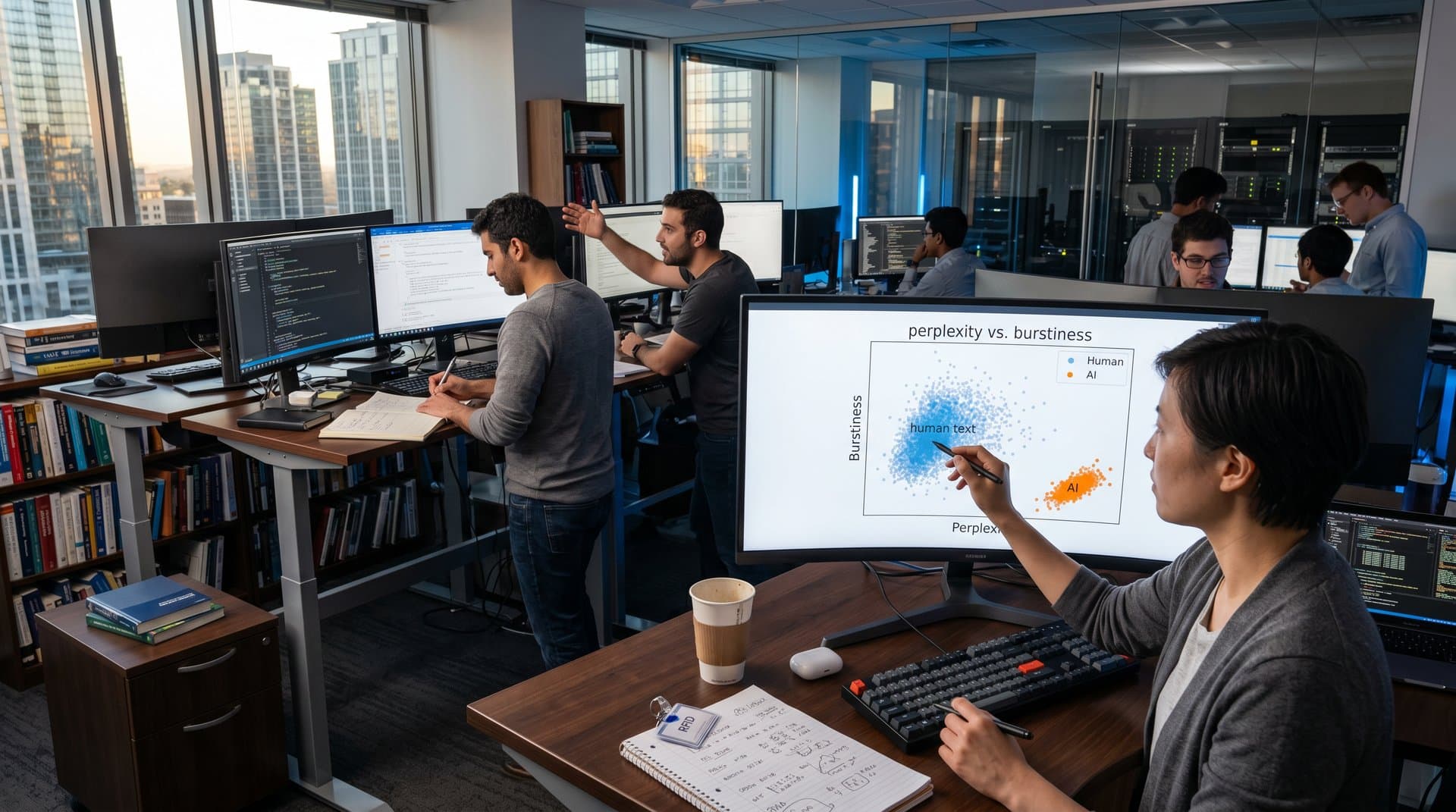
Clarence created a scatterplot with x-axis perplexity (linear scale, 10-50) and y-axis burstiness (linear scale, 0.5-2.0). Human texts formed a diffuse cloud; AI clustered low. He analyzed 20 essays: 15 classmates (human) and 5 GPT-generated.
- Metric: Perplexity · Human Avg (n=15, GovTech 2024): 28 · AI Avg (n=5, GPT-2): 12 · Clarence: 26
- Metric: Burstiness · Human Avg (n=15, GovTech 2024): 1.4 · AI Avg (n=5, GPT-2): 0.7 · Clarence: 1.5
Scatterplots Outperform Single Probabilities
A lone 39% scalar hides multidimensional patterns. Scatterplots harness preattentive vision for instant 2D revelation. Clarence's point aligned with classmates; GPT-4 simulations drifted lower.
Replicate in Tableau: Drag perplexity to columns, burstiness to rows, color by author type (human blue, AI orange). Apply small multiples by essay topic per Stephen Few's guidelines. Remove gridlines to maximize data-ink ratio.
Perception Science Backs Scatterplot Choice
William Cleveland and Robert McGill's 1984 Bell Labs studies show scatterplots halve error rates versus tables. Humans detect 2D clusters in under 200 milliseconds. Add bubble size for n-gram diversity.
Clarence computed metrics with Python's Hugging Face Transformers library and exported CSVs to Tableau. Analysts replicate on OpenAI's public benchmarks, using logarithmic axes only if needed.
Data Science Lessons from Avoiding Detection Pitfalls
Avoid 3D pie charts and gauges, which distort by 20-30% per Edward Tufte's principles. Use unit bar charts: 39 AI-like words vs. 61 human-like per 100 tokens.
Tufte's data-ink ratio demands sparse designs. Test dashboards on blind samples to validate clusters.
Step-by-Step Guide to AI Fingerprint Dashboards
1. Prepare data in Python or R: NLTK computes burstiness as sentence length standard deviation. GPT-2 tokenizer calculates perplexity.
2. Generate Seaborn scatterplots with regression lines for human/AI trends.
3. Import to Looker Studio: Add filters for topic, tooltips with scores, trend lines.
4. Validate on OpenAI's Human vs. GPT benchmarks (2023). Systematize for enterprise.
Building Layered Dashboards from Student Case
Layer histograms of perplexity at top for distributions. Place scatterplots in middle for correlations. Add word clouds at bottom, sized by frequency variance. Gestalt proximity groups human texts.
Universities pilot these amid Turnitin controversies. Deploy via Streamlit or Shiny for interactivity.
Implications of Visualizing AI Fingerprints
Clarence paired visualizations with narrative: "My scores match the class average." Stephen Few's hierarchy ensures clarity.
Detectors evolve, but analysts innovate with semantic heatmaps and entropy plots. Visualizing AI fingerprints drives data justice in disputes. GovTech, Wired, and Turnitin confirm reliability.
Frequently Asked Questions
What is visualizing AI fingerprints?
It plots perplexity and burstiness to separate human and AI text. NC student's scatterplots refuted 39% flag by clustering with humans.
How accurate is Turnitin?
Turnitin flags probabilities like 39% but hits false positives. Visualizations counter with metrics from GPT-2 on class essays.
How to build in Tableau?
Export Python perplexity CSVs. Drag to rows/columns, color by type. Small multiples and no gridlines per Tufte.
Why scatterplots for disputes?
They show two metrics for intuitive outlier detection. Studies confirm 50% fewer errors than tables or scalars.